

A World Built From Holding On
I began building this world in late 2019, around the beginning of the pandemic. At first, I only wanted the work to feel strange, mysterious, and difficult to fully explain. I was interested in images that felt emotionally loaded without immediately revealing why. But as the world around me became more politically charged the paintings slowly stopped feeling like isolated surrealist pieces and started becoming fragments of a larger narrative.
Grief became one of the biggest forces behind that shift.
Around that time I was deeply affected by a painting called The Lunatic of Étretat by Hugues Merle, which depicts a grieving mother clutching a wooden log dressed in baby clothes. I was also inspired by the series Servant, where a grieving mother becomes emotionally attached to a doll she believes is her child. Both works explored something I could not stop thinking about: the human urge to preserve what has already been lost.
That idea eventually became the foundation of the Risperdolls.
I began imagining a world where machines had advanced enough to emotionally resemble the people we miss. Not true resurrection, but something far more psychologically complicated. A presence. An echo. A performance convincing enough to blur the line between real and manufactured.
The name “Risperdoll” itself is a play on Risperdal, an antipsychotic medication. The title reflects the tension at the center of the work: grief, perception, emotional attachment, spirituality, delusion, healing, and the fragile line separating them.
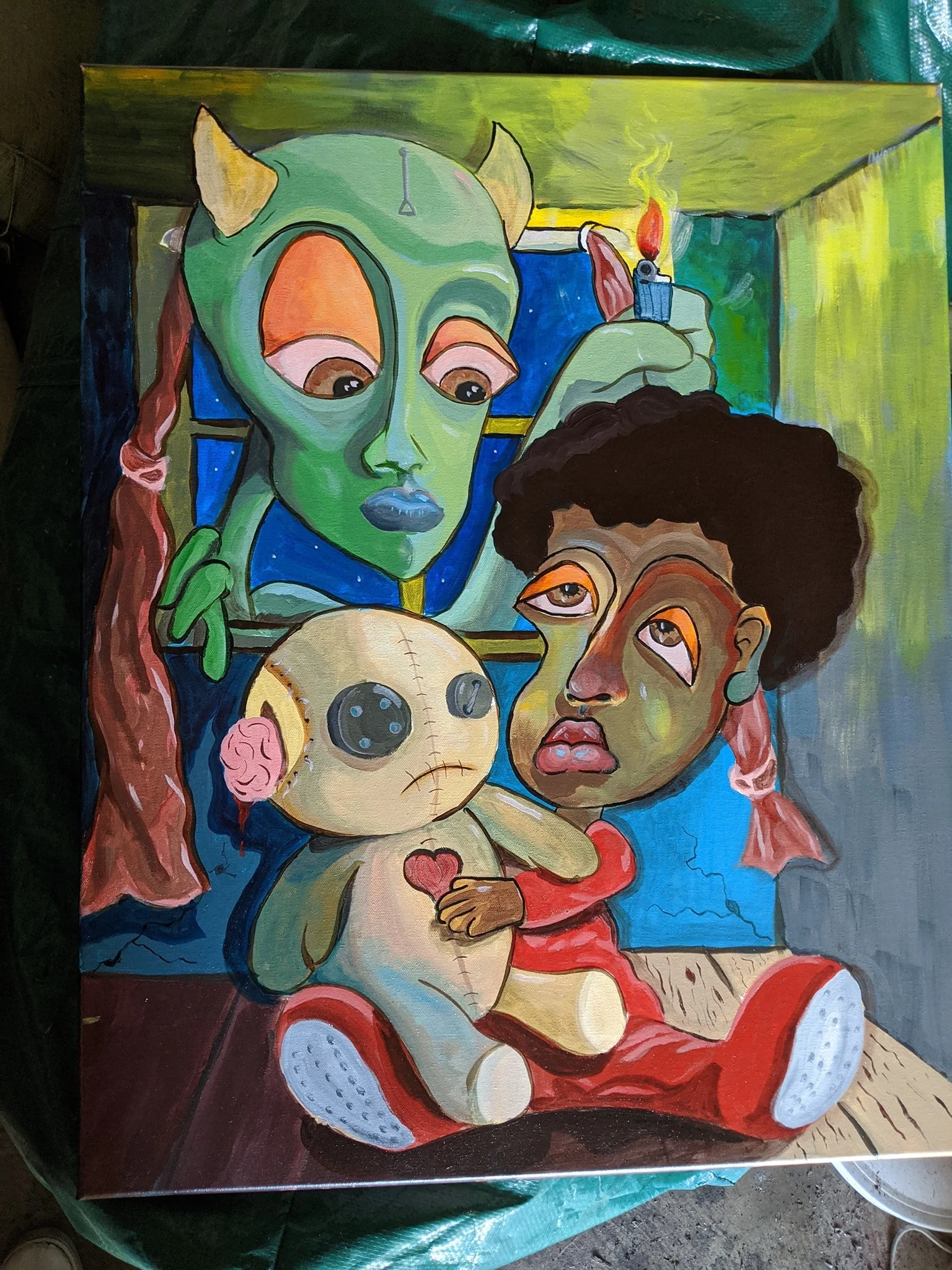
The first painting titled “DUMSOR” from early 2020. The M in DUMSOR stood for ‘Martian’ before I ultimately reused the name and changed it to ‘Machine.” A mysterious entity shows up to assist in the repair of a child’s doll. The power of grief was a common theme in my work.
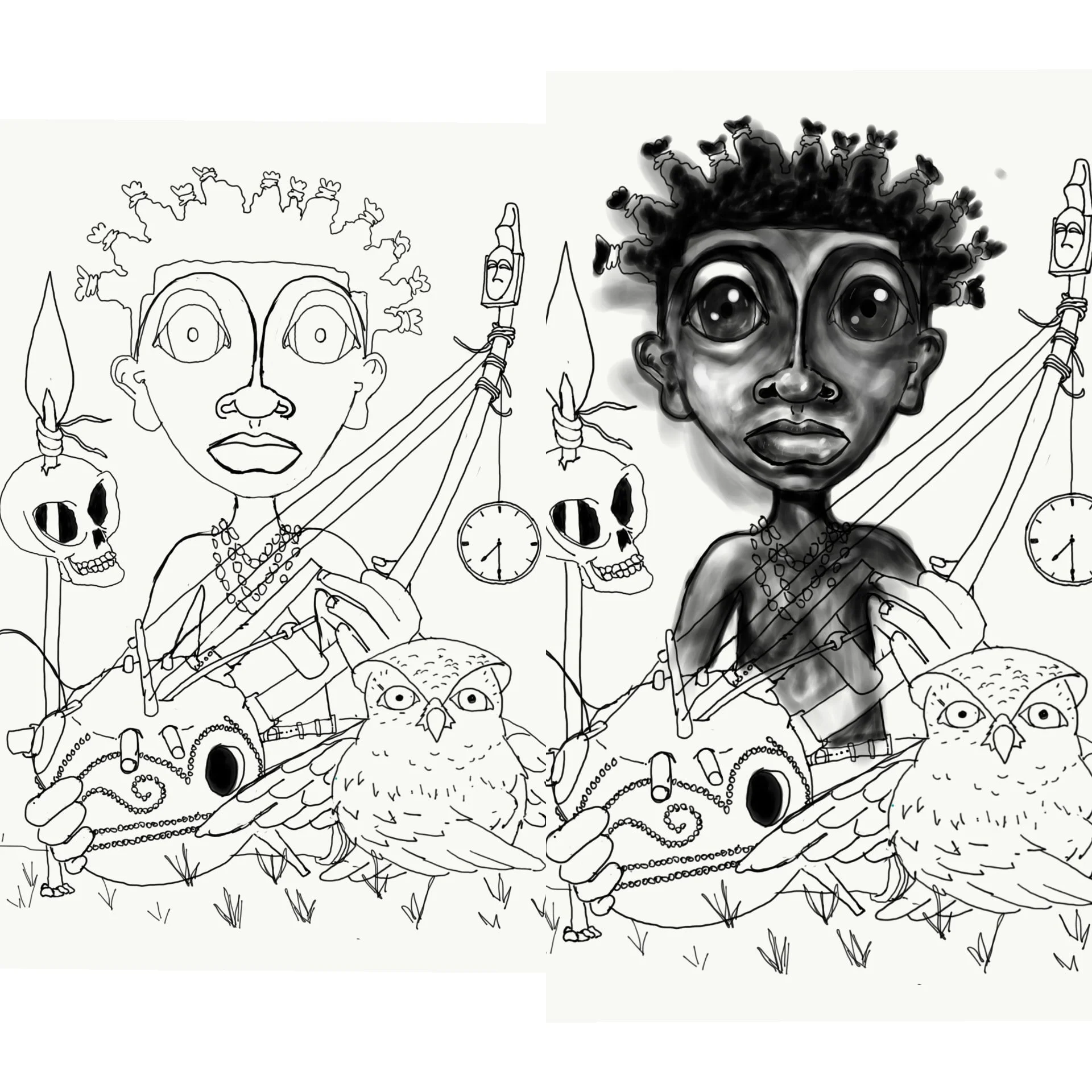
Early 2020 sketch of the Boskop Transmitter, 2020. I began experimenting with the idea of machines.
The Uncanny, The Doll, and The Mask
I intentionally avoided making my characters look too realistic. Realism weakened the emotional effect I was searching for. I wanted viewers to experience a kind of uncertainty when looking at the figures, something closer to the uncanny valley.
Artists like Mark Ryden, Todd Schorr, Greg Simkins, and Ten Hundred influenced me heavily during this period, especially in their use of surrealism, character design, and symbolic storytelling. I was also fascinated by how Pablo Picasso drew inspiration from African masks and abstraction. That ability to deconstruct visual language and rebuild it emotionally always stayed with me.
Another major influence was Margaret Keane. Her figures carried a sadness that felt emotionally familiar to me. Not devastated. Not joyful. Just uncertain. Like someone suddenly placed in an unfamiliar world trying to understand where they are.
Eventually, after months of experimentation, I arrived at the visual language that would define the work through a painting titled The Boskop Transmitter. That piece became a kind of blueprint. The large heads, symbolic distortion, asymmetry, exaggerated eyes, and doll-like forms stopped feeling stylistic and started feeling necessary.
At first, each painting existed independently. I would invent possible identities for the automatons, imagining who they once represented and why they were preserved.
But eventually another question emerged:
Why would anyone preserve people this way in the first place?
The answer could not remain personal forever. If I wanted the work to continue expanding, the motivation behind the preservation had to become larger than a single family or isolated tragedy. It had to become about memory itself. About history. About humanity attempting to hold onto itself during collapse.
That realization transformed the work into a narrative universe.
The world evolved into a future where all human activity had eventually become recorded, archived, and surveilled. A powerful regime known as D.U.M.S.O.R (Directive for Unified Mechanized Surveillance, Order, and Regulation). manipulates truth, controls information, and distorts collective memory, while a mysterious builder known only as “The Doctor” creates automatons called Risperdolls to preserve fragments of authentic human experience before they disappear entirely.
What began as surrealism slowly became mythology.
The automatons became metaphors for grief, memory, identity, emotional inheritance, addiction, spirituality, and the psychological consequences of control.
From Isolated Paintings to a Living Narrative
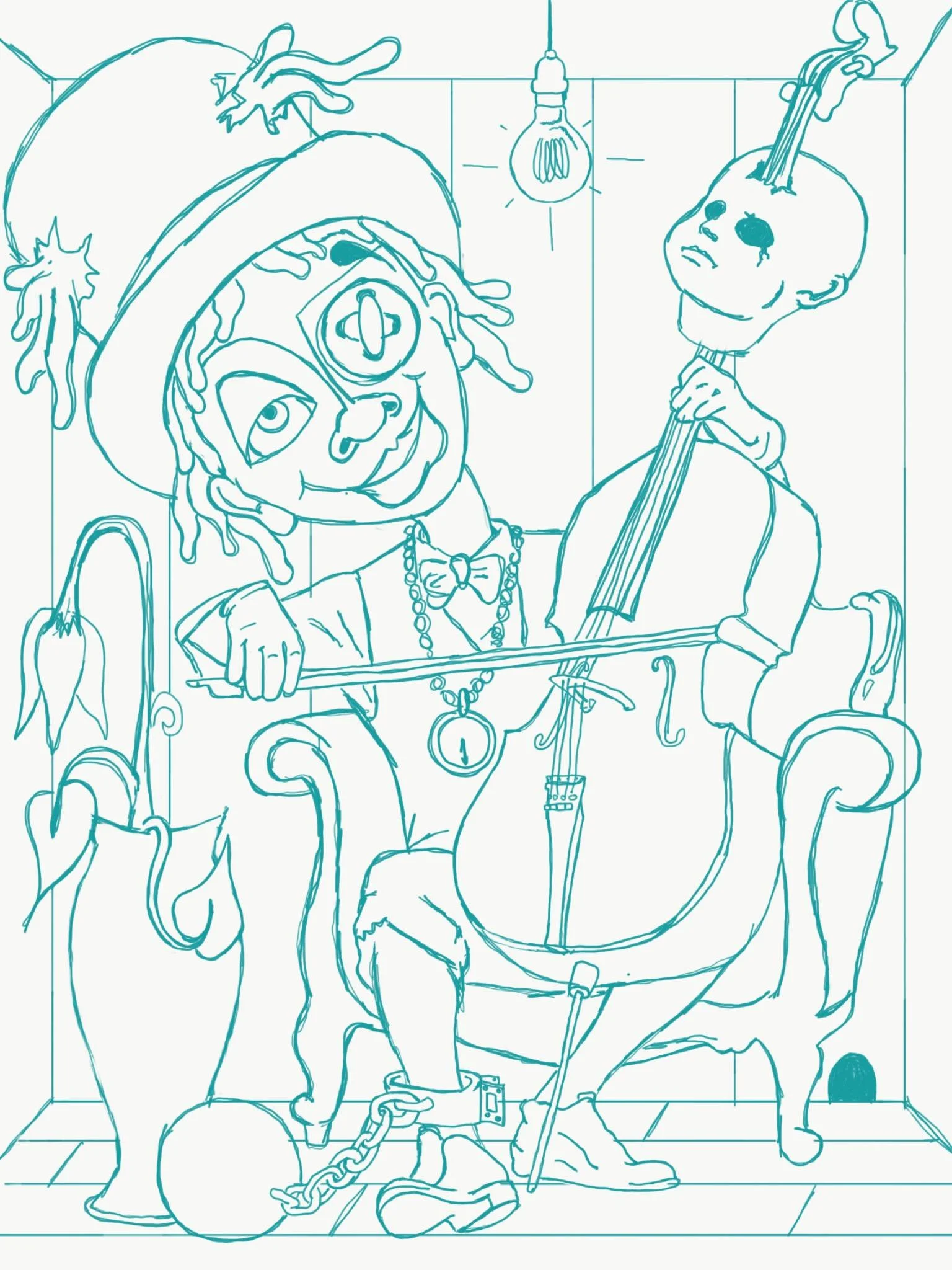
A digital sketch for “The Baron of Manchac Swamp” originally titled “The Psychotic Samedi” 2020. This piece is where I started playing with the idea of the characters being vessels. Within the process of this piece, the vessels idea went from ‘possession’ to ‘upload.’
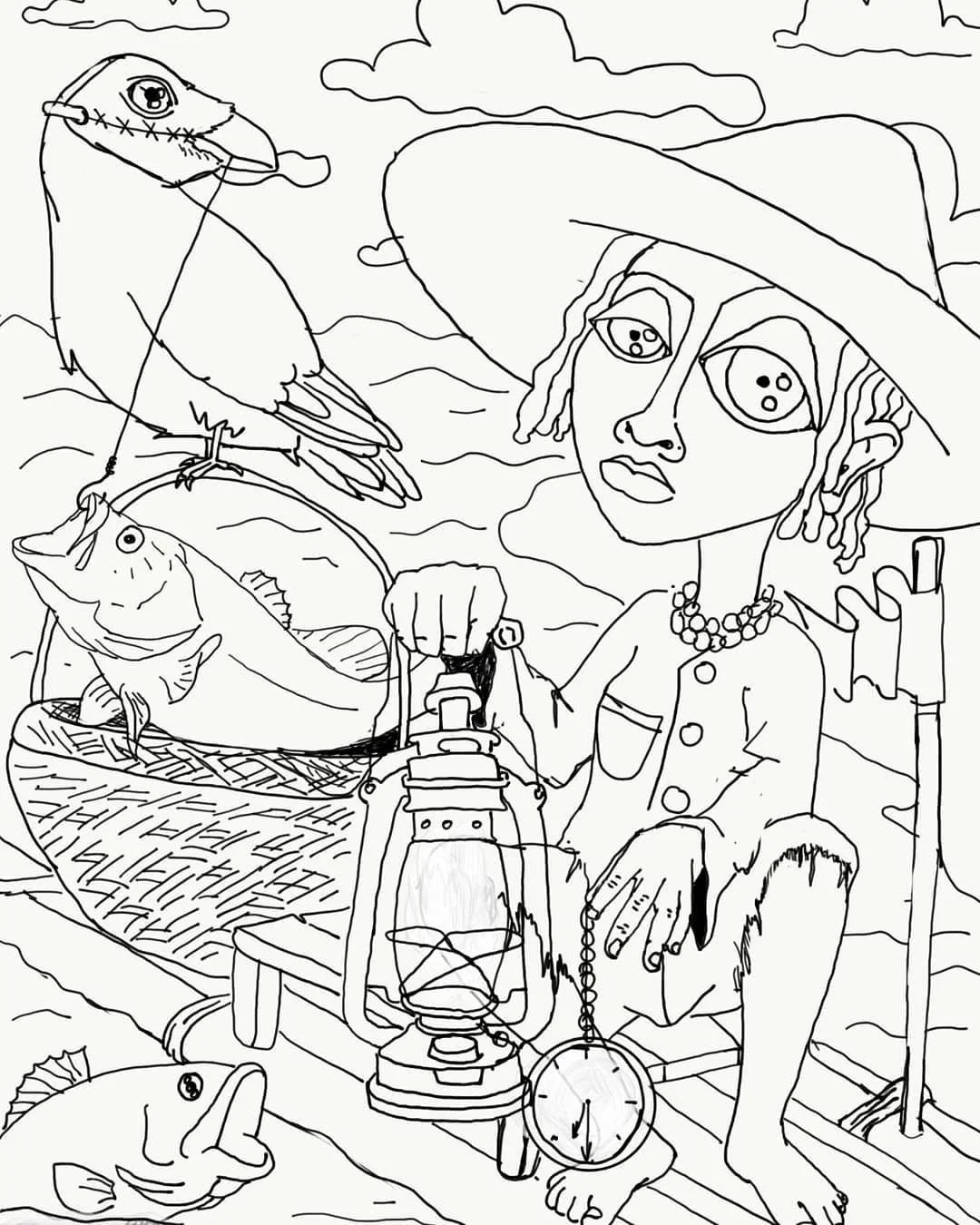
Digital sketch for “The Haints River Lamp Guide” 2021. My first time using the lantern. Originally meant to attract, by the time I finished the piece it became a symbol of guidance.
Control vs. Surrender
Over time I realized the work was really about one central idea: control versus surrender.
The paintings often begin with structure and intention. I start with symbols, systems, themes, or narratives I think I understand. But somewhere during the process the work stops behaving the way I originally planned. The paintings begin redirecting themselves. Meanings shift. Characters evolve. Entire themes emerge that I never intended at the start.
The art develops autonomy.
That experience became embedded into the mythology itself. The automatons are symbolic of creations that outgrow their creators. Human beings constantly attempt to control what they build, only to eventually realize that control is incomplete.
Surrender became just as important to the work as invention.
Not surrender as defeat, but surrender as acceptance. Acceptance that growth changes things. Acceptance that truth evolves. Acceptance that healing often requires releasing the fantasy of total control. Or what one might call Step 3.
Recovery, Healing, and The Akashanauts
During the years I was developing this world, I was also struggling heavily with alcoholism. I had been drinking since I was young, had stopped for periods of time, then returned to it heavily during COVID.
In early 2025, after realizing I needed to heal mentally and emotionally, I joined a 12-step recovery program. That experience profoundly changed both my life and the meaning of my work.
At the same time, I was attending classes focused on substance abuse, mental health, coping mechanisms, and emotional regulation. During these sessions I started drawing small robotic figures and pairing them with reflections and poetry connected to whatever topic we discussed that day. It unintentionally became a form of journaling.
These drawings eventually evolved into what I now call “The Akashanauts.”
As I continued through recovery, I became deeply interested in the ways people heal through connection and shared understanding. I noticed how often moments of clarity arrived unexpectedly through simple interactions with others. In recovery circles people sometimes refer to these moments as “AH-HA moments,” sudden experiences of deep and necessary understanding.
Those ideas became central to the mythology.
The Akashanauts are not heroes because they gain power. They are seekers attempting to understand themselves, each other, and the emotional consequences of existence itself. Their journeys mirror many of the same ideas I encountered in recovery: humility, responsibility, grief, truth, surrender, healing through service, and the realization that control alone cannot save us.
The doodles that eventually lead to the Akashanauts.
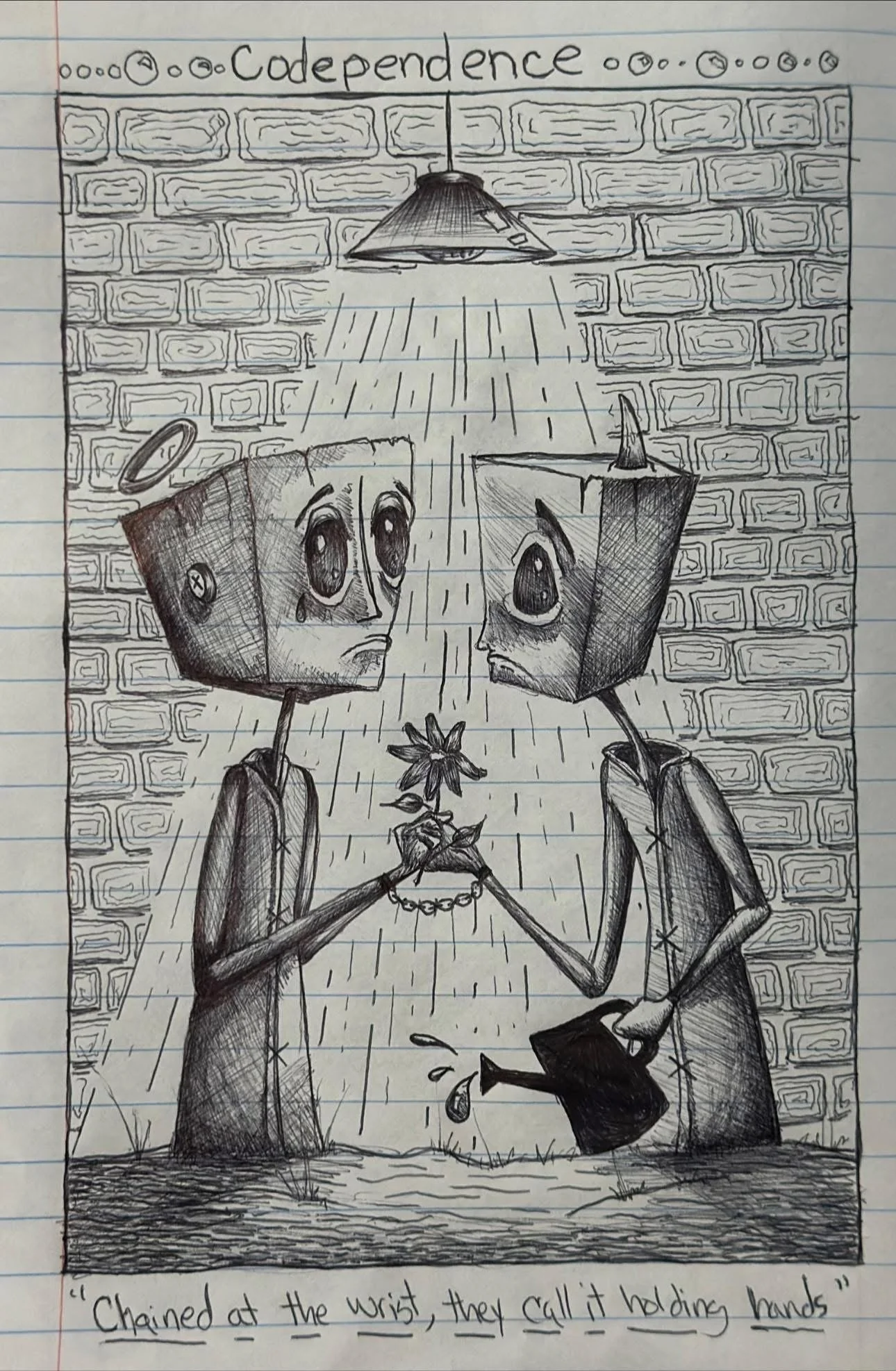
One of the first drawings created during the classes that later became the foundation for the Akashanauts.
Why I Continue Building This World
Although the work contains science fiction, automatons, rituals, symbolism, and surrealist imagery, the emotional core is deeply human.
The paintings are about fear.
About loneliness.
About memory.
About addiction.
About identity.
About political manipulation.
About emotional inheritance.
About grief.
About the strange ways people try to survive psychologically in unstable systems.
Most importantly, the work explores what happens when people lose their connection to themselves, to each other, and to truth.
The Risperdolls, Akashanauts, lanterns, archives, and fractured systems are all metaphors for that struggle.
I do not see this world as escapism. I see it as translation. A symbolic language for emotional and psychological experiences that are often difficult to explain directly.
My hope is that viewers can enter the work through whatever doorway feels familiar to them. Some people connect through the storytelling. Some through the surrealism. Some through the symbolism. Some through recovery, grief, or spirituality. Others simply connect to the feeling that the figures themselves seem emotionally alive.
In the end, the work asks the same question over and over:
What parts of ourselves are we trying to preserve, and what happens when we can no longer control the outcome?