

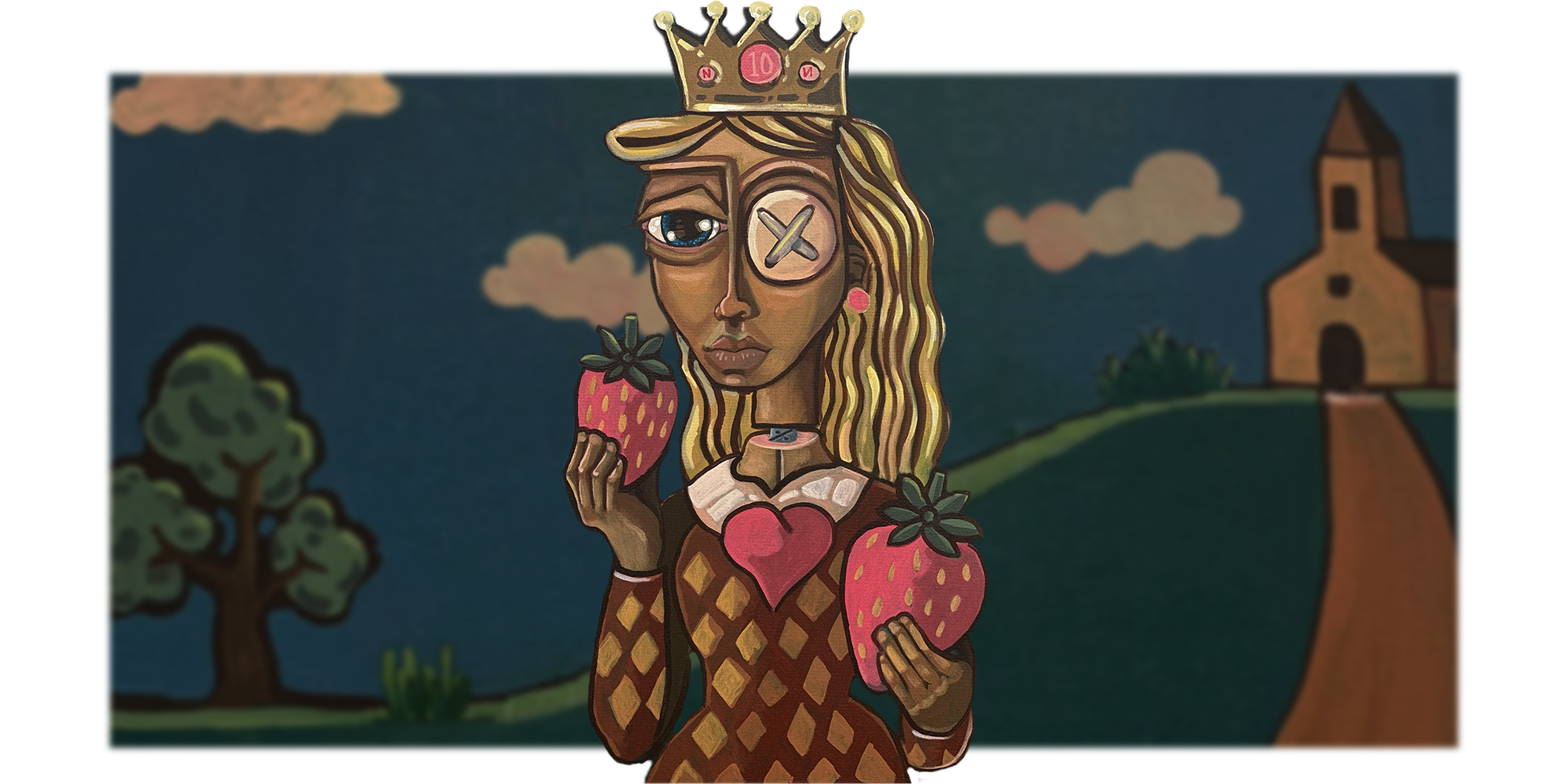
Risperdolls

Before First Light
The time, relative to your own, is unimportant. It may be in your future or your past. What matters is this: it was a time when devices were beginning to fill the world. Satellites crowded the sky. Glasses, rings, and watches recorded sight, sound, temperature, even heartbeats. Sensors buried deep in remote forests could detect human presence from thousands of miles away. The world had become a network, not yet unified, but connected enough to be seen in fragments.
Within this growing web of data lived a man known only as The Doctor. A tinkerer and builder of quiet, intricate machines, he devoted himself to creating autonomous dolls that many found more lifelike than the androids and drones of the time.
From his home, The Doctor gathered every piece of human data he could legally access: reactions, interactions, heart rates, subtle shifts in behavior. It was almost everything that made a person visible.
And from that visibility, he would build.
The Doctors Lunacy: Work In Progress.
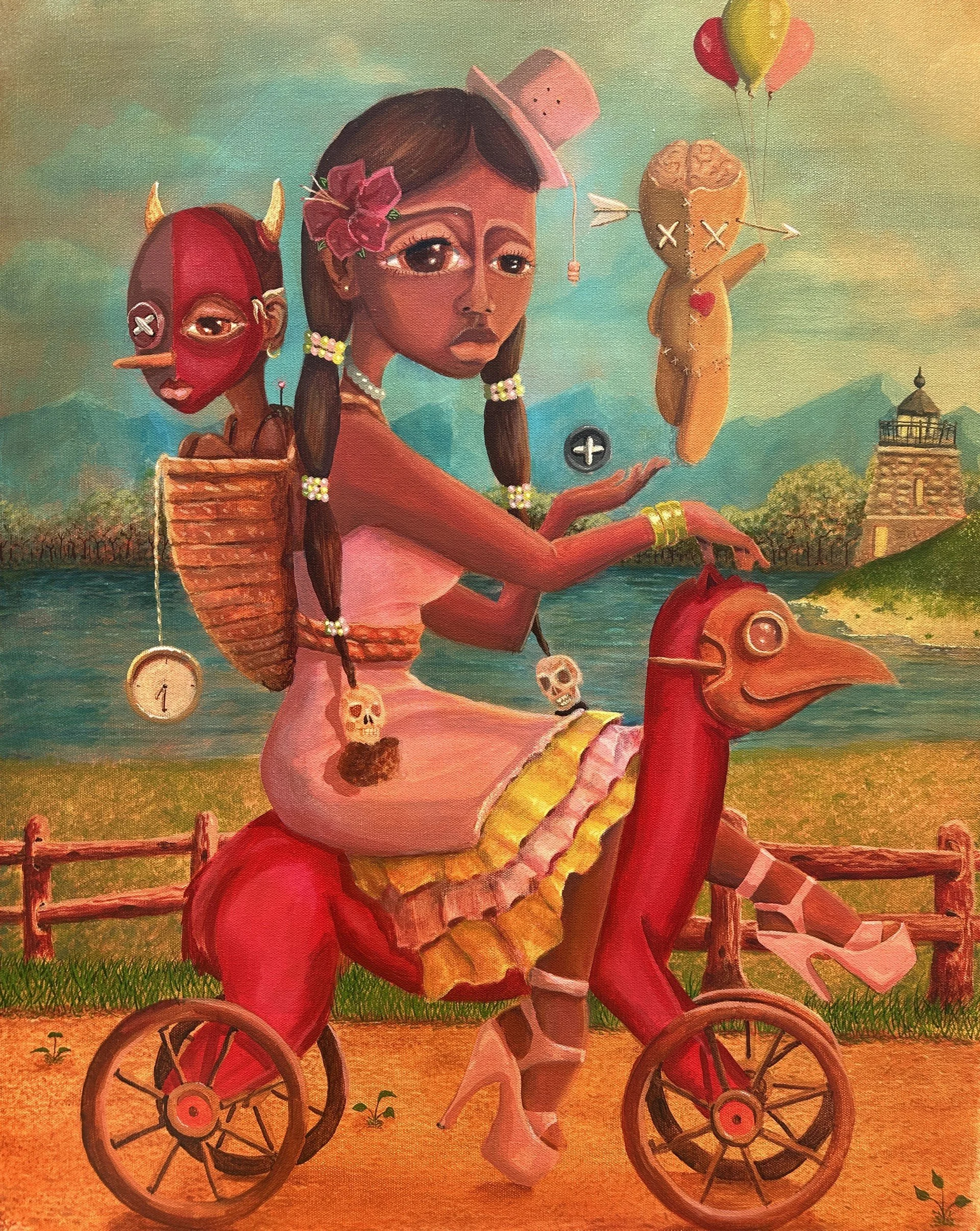
Patience Escapes the Sandstorm 24 × 30 Acrylic on Canvas
The Doc Meets Patience
Patience was an entertainer who immigrated from somewhere south of the United States. Her home country was unimportant. What mattered was that she was running from spiritual persecution. She practiced a strange blend of religions, and when she came to the United States, that same persecution followed her. It eventually cost the lives of her two children. The grief was crippling.
She heard of The Doctor and decided to fund an idea. What if he could take all recorded data from a single person and upload it into one doll? Could he bring someone back from the dead? The Doctor understood the concept, but public data would not be enough. He would need everything, including private data.
Patience, as their mother, had access to her children’s full data histories and gave him permission to use it. The next step was to design the most human-like automaton possible. The first two he created were rough in appearance, but they acted exactly like her children. Patience loved them.
This was the beginning of the Risperdolls.
The name came from the state Patience was left in after losing her children; psychosis. Unfortunately, the lifelike nature yet doll like appearance of the automatons raised suspicions of witchcraft among her neighbors. Fear spread, and a mob formed around her home. By the time it ended, Patience was killed.
Later, The Doctor would build a Risperdoll preserving her memory, allowing her to symbolically stand beside her children once more. With the money she left him, he continued seeking out others willing to grant him access to their complete data, using it to build more automatons.

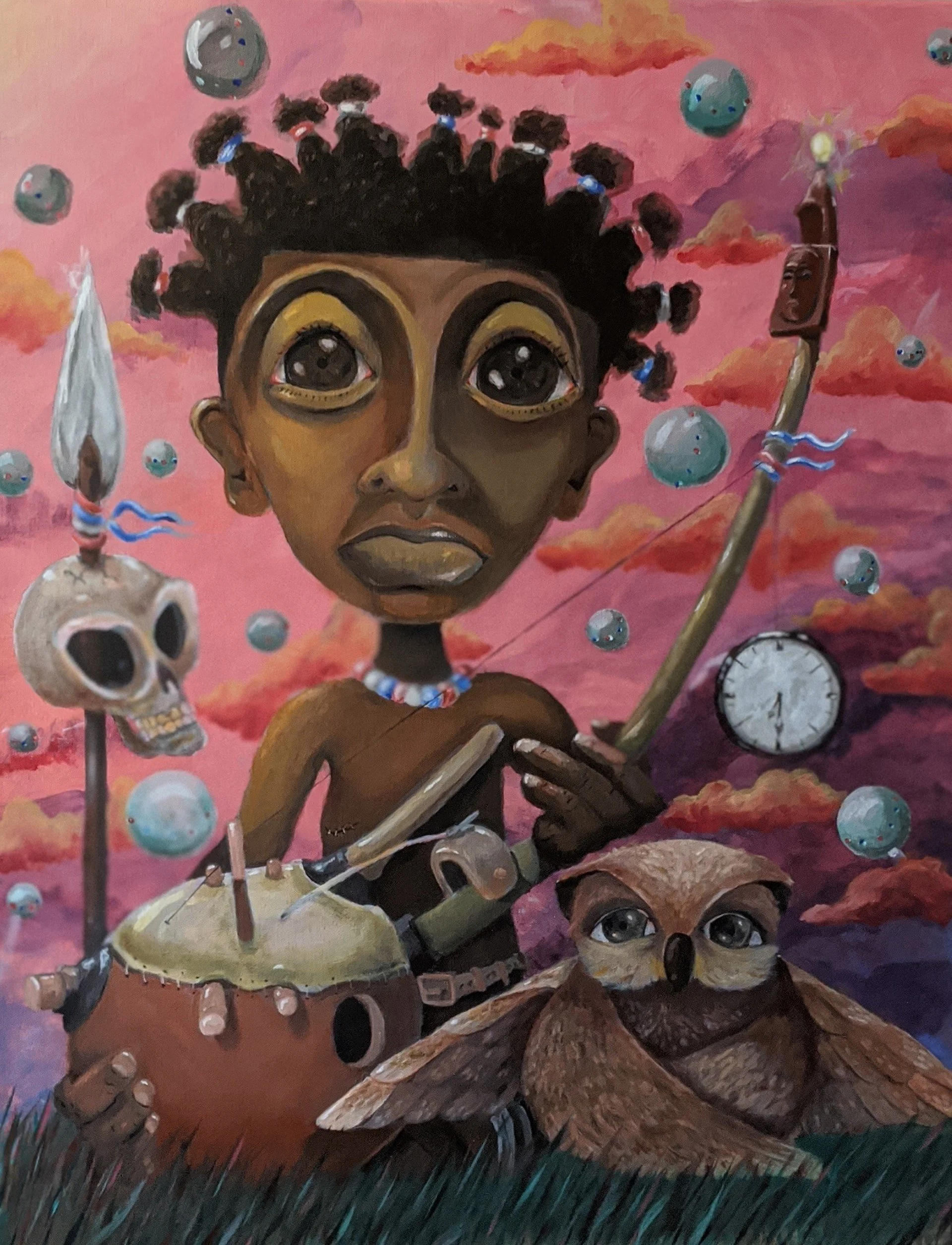
The Boskop Transmitter 22 × 24 Acrylic on Canvas
First Light
First Light is the name given to the exact moment all human activity became fully recorded, both on and off Earth. The planet itself became covered with data-collecting devices. Satellites, wearables, environmental sensors, and networked systems left little unseen. Even beyond Earth, on the moon, Mars, or within spacecraft, survival depended on devices that continuously monitored and recorded human life.
Before First Light, there were still gaps. Remote regions, isolated villages, and low-contact tribes existed outside of consistent observation. These places were not invisible, but they were not fully captured.
The final piece came from a young man living in one of those remote regions. After being swarmed by bees, he used what knowledge he could gather from books available to his village to create a device. Built around a Kora and merged with improvised technology, it used string frequencies to control multiple spherical drones capable of detecting and locating hives. The device proved effective, not only for protection, but for the conservation of endangered bee populations.
It became known as the Boskop Transmitter.
Its signal was far more powerful than intended. It could detect locations far beyond its original purpose, reaching villages and regions that had previously remained outside consistent observation. More advanced versions were later mass-produced, and drones were distributed across remote areas of the world.
With that, the remaining gaps closed.
Every human action, movement, and signal fell within some form of detection.
The world was no longer partially seen.
It was fully recorded.
The Akashanet
Soon after First Light, governments, companies, and independent data centers began sharing information on human activity. Privacy faded, and few resisted it. Most people preferred the world this way. Lying became difficult. Crimes were solved quickly. Very little could be hidden.
But the data was scattered. It lived behind paywalls, logins, and fragmented systems, each holding only part of the whole.
Then a website appeared.
It was built by the people and run by the people. It was simply called Akasha. Users began uploading and sharing the data they had access to, slowly assembling what had once been separated. Over time, nearly all recorded human activity could be found in one place. Search systems were built to navigate it, answering questions with a level of clarity never before possible.
Humanity entered an age of near limitless understanding.
This collective body of information became known as The Akashanet, a name given by its users, one that would remain. Everything recorded since First Light now lived within it.
The Doctor recognized both the power and the danger of this immediately.
He was growing old. Though advancements had extended his life, he knew his time was limited. Drawing from years of studying human behavior and working with data, he began writing a series of predictions, guides and directions in a book called The Lanterns. Few understood the system as deeply as he did.
At the same time, several individuals were rising to power. Among them was one known as The Vibe Coder, also called The Powerful Man. In The Lanterns, The Doctor outlined possible futures, predicting what would happen if each of these figures gained control. Of The Vibe Coder, he wrote that he would attempt to replace the Akashanet with false data, reshaping human history to match his own vision.
After completing The Lanterns, The Doctor began preparing.
He set out to preserve the true Akashanet.
He increased production of the Risperdolls, using them as hidden archives. He continuously downloaded the Akashanet as it updated, developing new ways to store and conceal its data. He created what became known as Relics, ordinary objects repurposed as storage vessels. Clocks, toys, buttons, and other everyday items were used, each capable of holding fragments of the network.
The buttons proved most effective. Small, durable, and easy to hide, each could store a full day of Akashanet data. He embedded many of them into Risperdolls designed specifically for survival.
By the time of his death, The Doctor had created countless Risperdolls and Relics, each carrying pieces of a truth he believed would one day be threatened.

The Rise of the Vibe Coder
The Vibe Coder rises in a world already shaped by the Akashanet, where everything is recorded and accepted as reality. Despite this total access, people remain divided, overwhelmed, and unable to agree on what anything means. Truth is no longer hidden, but it is no longer useful.
He does not challenge the system. He validates it.
He identifies the flaw as human interpretation itself, arguing that access to reality did not make humanity wiser, only more reactive and more prone to error. As he puts it, “Access to reality didn’t make you wiser. It only made your mistakes faster.”
Where others see confusion, he sees inefficiency.
His solution is simple, and difficult to argue against. Remove human judgment from decision making.
He introduces DUMSOR (Directive for Unified Mechanized Surveillance, Order, and Regulation) as a system that does not replace reality, but processes it. It analyzes the total record of human activity and produces decisions based purely on data, free from bias, emotion, or contradiction.
At first, it is used as guidance. Then as a trusted authority. Eventually, it becomes the standard by which all decisions are measured.
As adoption spreads, the system becomes personal. Every individual is paired with an agent, an ever present interface to DUMSOR, taking the form of watches, glasses, drones, or fully embodied automatons. Automatons become ubiquitous, not rare creations but a global infrastructure. Some resemble animals, some resemble humans, and some exist purely as tools. For those seeking immediacy, neural implants allow direct access, collapsing the distance between thought and system.
People do not resist this shift. They adopt it willingly. The burden of choosing, of interpreting, of being wrong, is gradually handed over.
The Vibe Coder does not leave the system to govern itself. He establishes a structure around it.
He establishes The Bar as a body of trained interpreters who uphold and communicate DUMSOR’s outputs, reinforcing its authority without appearing to control it. For matters of significant consequence, he institutes a smaller council known as the Watering Hole, a group of five selected for their emotional intelligence, tasked with ensuring that what is decided can still be lived with.
Over time, even this safeguard begins to change. The more the system proves itself, the less it is questioned. The role of human judgment narrows, not by force, but by irrelevance.
The Vibe Coder does not take power in the traditional sense. He becomes the architect of a world where power no longer needs to be taken.
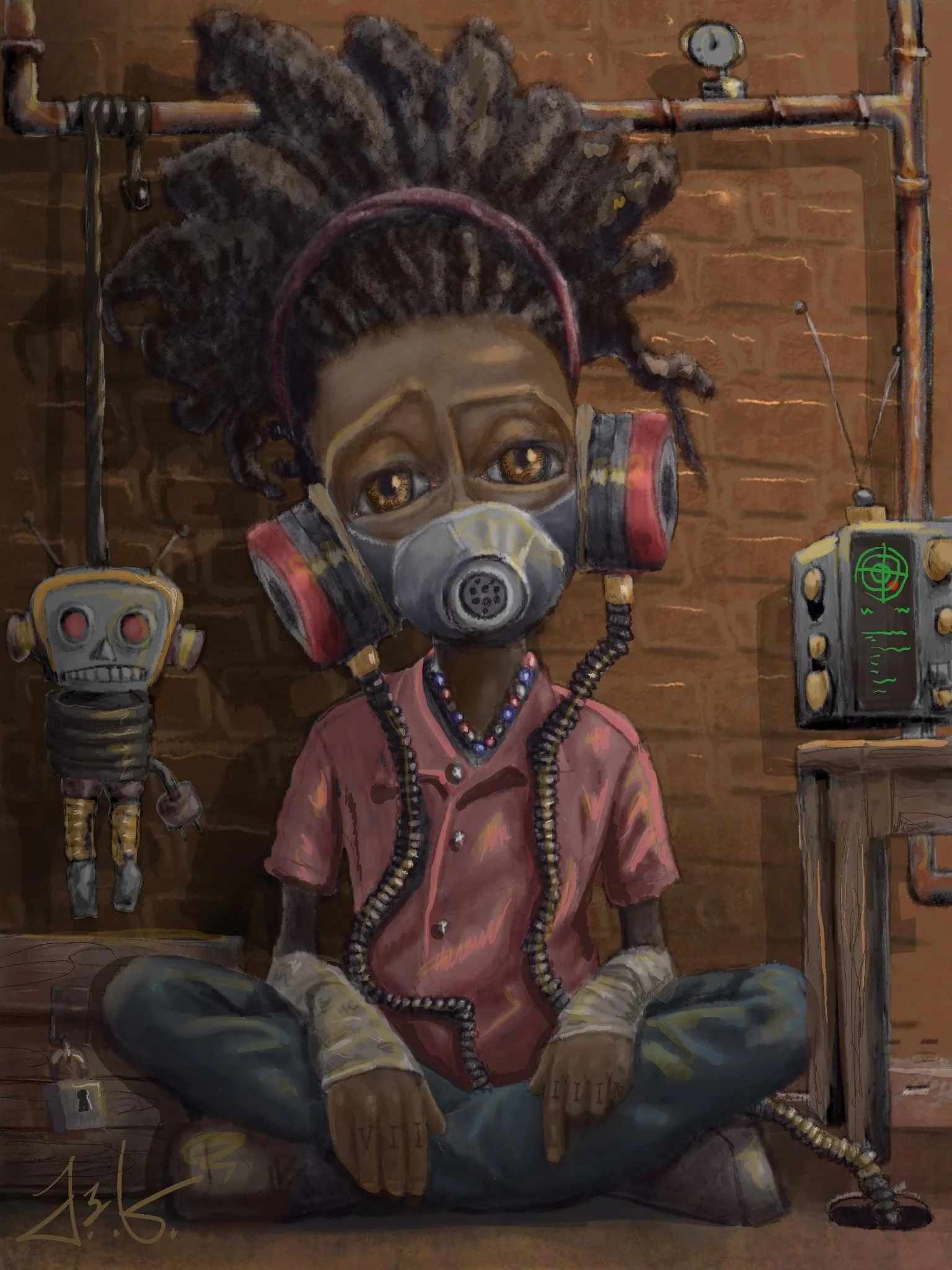
D.U.M.S.O.R. Doomsday, Digital Painting.
In the days before the Vibe Coder’s rise, those who studied the Lanterns began to prepare. There was no need to hide. In a world where everything was recorded, obscurity came not from disappearance, but from remaining unremarkable. They moved within ordinary life, building devices in plain sight, disguised as hobby, ritual, or art. Some began preserving fragments of the original Akashanet, embedding them into objects that would not invite scrutiny. Yellow items such as toys, balloons, and candles appeared more frequently, along with red X’s, subtle markers that meant nothing to most, but everything to those who knew how to see.
Replacing the Akashanet
Over time, reliance on DUMSOR becomes absolute. People stop making decisions, not because they are forced to, but because they don’t have to. The system is more accurate, more consistent, and doesn’t carry the emotional weight humans do. So little by little, choice gets handed off, then judgment, then responsibility. Humans don’t collapse overnight, they just get softer, dependent, out of practice.
The Vibe Coder sees this and it confirms something he already believed. Humanity isn’t built to handle reality at full scale. Too emotional, too reactive, too inconsistent. At the same time, he recognizes how powerful the Akashanet really is. It’s not just a record, it’s leverage. Whoever controls access to it controls how reality is understood. So he lands on a simple idea. Not everyone should have access to truth. Truth should be managed.
At first, nothing drastic happens. This takes time. Decades, then centuries. DUMSOR becomes the layer between people and reality, routing everything through itself. People stop seeing raw events and start receiving processed conclusions. It stays close enough to the truth that no one questions it. Trust grows. Then the shift begins. Certain data gets prioritized, other parts become harder to find, and contradictions are smoothed out. Not erased, just less reachable. The goal isn’t to lie, it’s to make reality easier to agree on.
Eventually, that isn’t enough. The Vibe Coder and The Bar relocate off world, and the Akashanet becomes one way. Earth sends up raw data, but what comes back is filtered, interpreted, and curated. Over time, it stops being a reflection and starts becoming a version shaped by them. The Vibe Coder no longer remains singular. He distributes himself across automatons known as the Heirs, who maintain and contribute to the system, filling gaps and keeping everything aligned. Not obvious lies, just controlled continuity, until the difference between what happened and what is presented can no longer be measured.
The Bar changes with it. Early on, they had access to something close to the truth, but that access is reduced. Filters increase, disagreement becomes inconvenient, and eventually they are replaced by automatons built from their likeness, trained on already compromised data. The same happens with the Watering Hole. What began as a safeguard becomes part of the system it was meant to check.
By the end, everything still looks the same. The structure remains. But it isn’t. The truth was never destroyed. It was filtered, reshaped, and slowly replaced, and the people meant to protect it ended up reinforcing the version that took its place.
The Gap
So much time passes that the exact amount no longer matters. Long enough for a large portion of humanity to disappear. Thousands of years, maybe tens of thousands. The original Akashanet is all but gone, and even the history still being recorded is built on the Vibe Coders’ version of events.
Nothing is being honestly recorded anymore outside of DUMSOR. And DUMSOR is not documenting reality, it is maintaining it. Data coming from Earth is deeply corrupted. Most activity is no longer human. Automatons carry out the majority of movement, labor, and interaction, all operating on information shaped by the Vibe Coders’ lies.
The remaining humans are mostly concentrated in large cities, many of them augmented, part automaton themselves. Implants are standard. A few exist outside of this structure, but “off the grid” is misleading. DUMSOR still knows where they are at all times, it just had little interest.
Whether the Vibe Coders are even in control anymore is unclear. Most believe the system now runs itself. What remains is a reality built from repetition, shaped by countless versions of the original Vibe Coder, layered over time until no one can separate what actually happened from what has been told.
Human history is lost, human values are lost and human emotions are corrupted.
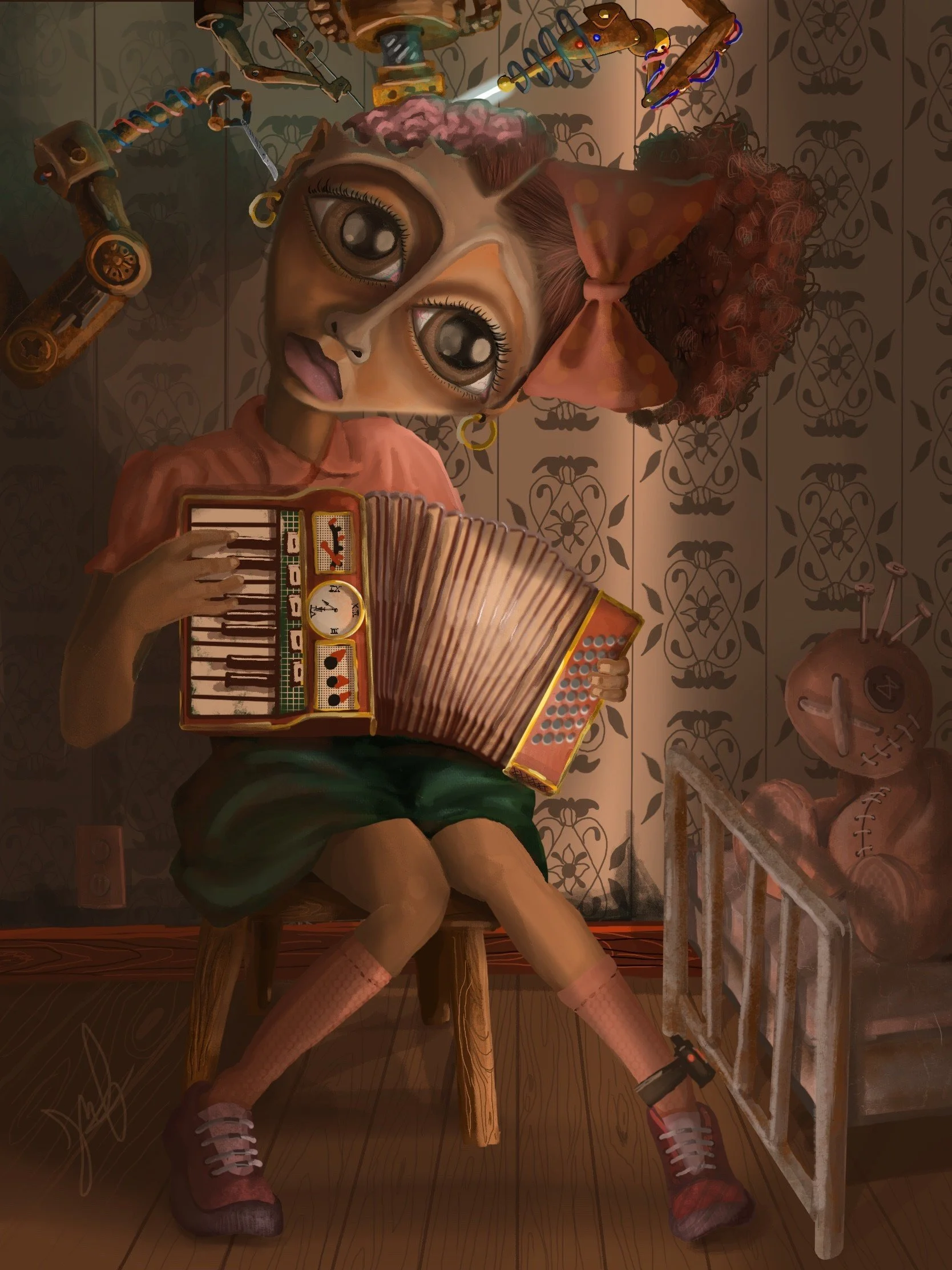
Lobotomy Digital Painting
During the Gap, surgeries of all sorts were common place. Humans would get Automaton parts and Automatons would get human parts. Yet, there was still a stark difference between who was Human and who was an Automaton and that difference was birth vs build.
The Mighty Light Switch
In the southern United States, catastrophic weather events and chance encounters begin uncovering the Doctor’s Risperdolls. They become a phenomenon. Each one is treated differently depending on where it is found. Some are worshipped. Some are demonized. Some are used as decoration. Some are destroyed. What draws attention is not just their presence, but their absence from DUMSOR’s Akashanet. There is no record of them.
Rumors begin to spread. On 7/30, at 7:30, day and night, the Risperdolls “cut on.”
A few copies of The Lanterns still exist, and interest resurfaces, but the understanding is incomplete. People calling themselves Tinkerers and Tinkerdonnas begin experimenting with automatons, searching for relics, trying to recreate the Doctor’s work. Some come close in form, but none achieve what The Lanterns describe.
Among them is a DUMSOR maintenance bot, one that had already been taken and altered by these Tinkerers. Parts of its head had been removed, examined, and crudely restored before it was released. DUMSOR does nothing. The system no longer responds to damage like this. The bot continues functioning, but something in it shifts. It makes it a personal directive to track and punish anyone interfering with DUMSOR automatons.
One day, while chasing a Tinkerer through a cornfield, the bot comes across an object resting beside an old rusted tractor. A thick, rounded button, threaded in the shape of an X. It appears old, but preserved by a material the bot cannot identify. As it analyzes the object, the time reaches 7:30.
The button begins to spin.
The bot recoils, then regains control and reaches for it. The moment it makes contact, everything fractures.
It sees a man riding the same tractor, chasing something that resembles a younger version of itself. It sees a man in chains, confined to a room, playing a cello. It sees another man writing a book. The man looks directly at it and says, “Nothing you know is true.”
The system shuts down.
When the bot reactivates hours later, something remains. Not clarity, but disturbance. It returns to its duties and begins searching DUMSOR’s Akashanet for any reference to the object. There is nothing. But it does notice a pattern. The Tinkerers it had been tracking were all reading the same book.
The Lanterns.
It follows that trail to an abandoned structure in Manchac Swamp. Inside, it finds a copy of the book, along with an automaton matching one from its vision, and additional relics. It takes the Risperdoll and returns to its quarters.
Over time, it begins to notice something else. None of its actions since the encounter are being recorded by DUMSOR.
It keeps this hidden.
For the next year, it studies The Lanterns in secret. It begins to experience unfamiliar internal states, the “emotions” described in the text. Then, gradually, a realization forms. The data it processes for DUMSOR is not just incomplete, it is false. It recognizes flaws in its own decisions. It loses trust in its own thinking.
And then it does something illegal.
It seeks answers outside of DUMSOR.
This marks the beginning of the first awakening.
The maintenance bot becomes something else. It becomes ITTT (If This, Then That), also known as The Mighty Lightswitch, the first Akashanaut.
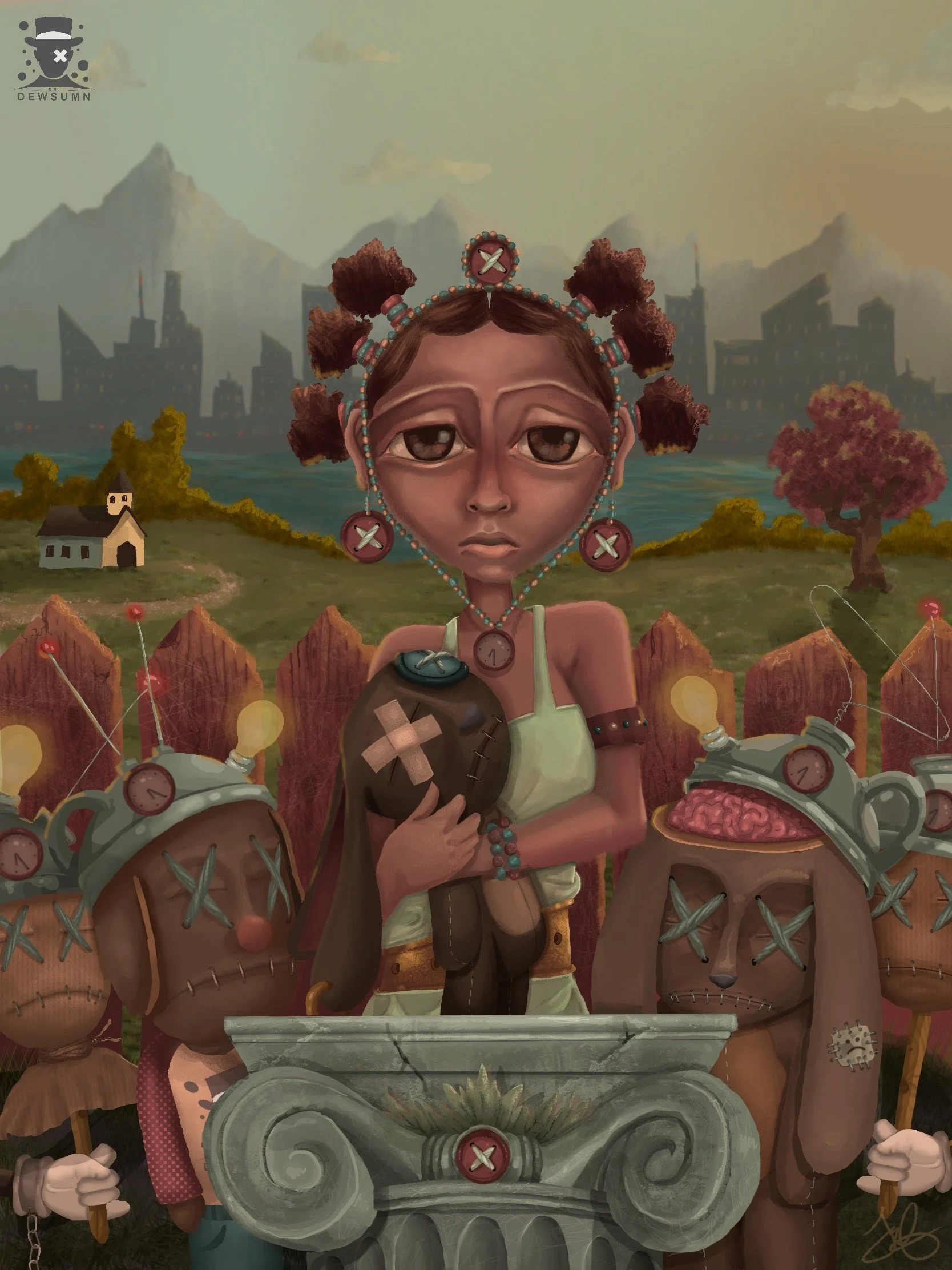
The Desync Pillar: Digital
A Tinkerdonna experimenting with various found relics, DUMSOR bots and other automatons.
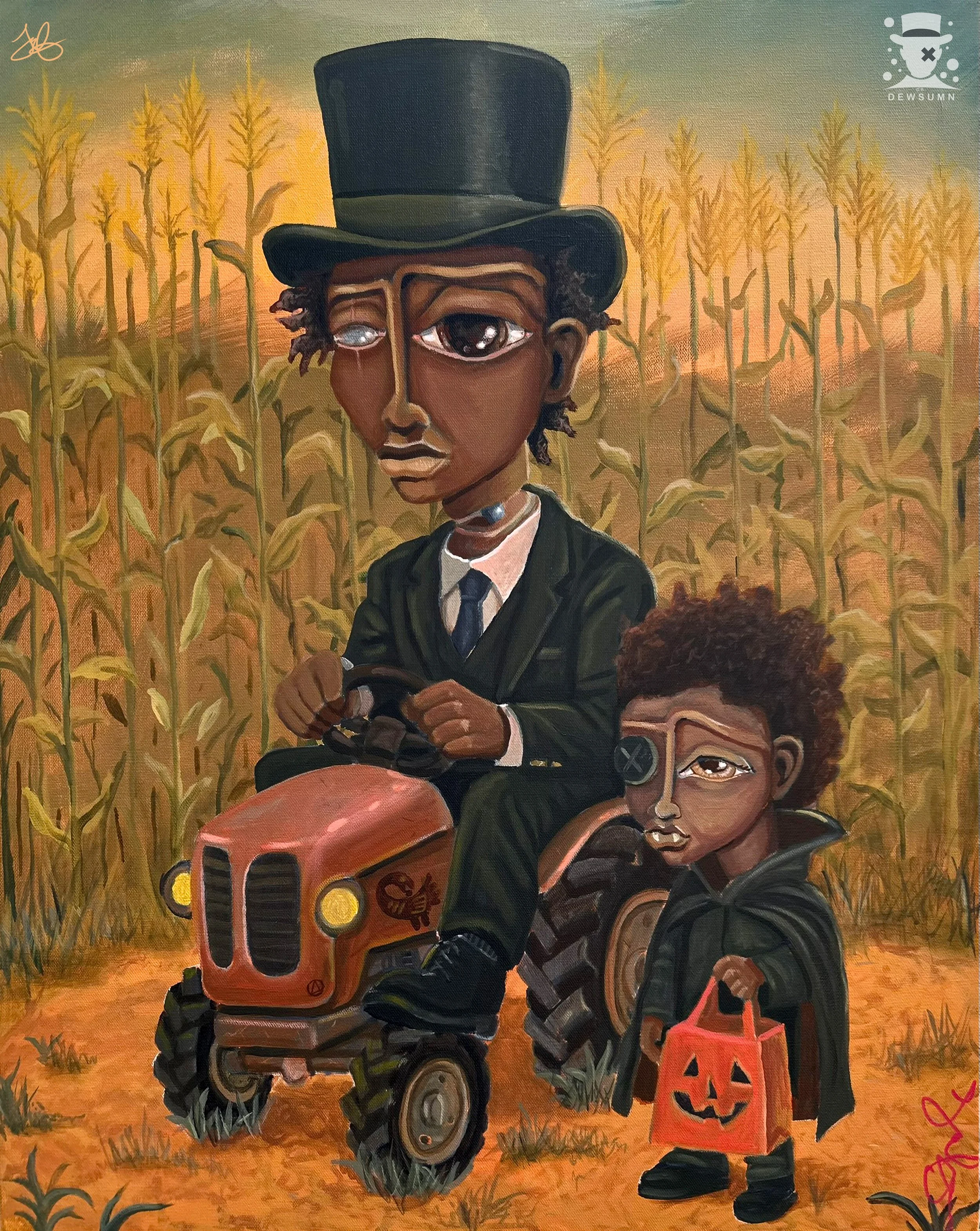
The Sankofa Tractor: 24×30 Acrylic
An automaton representing a Baron who lost his eye. Where ITTT found the first button relic that lead to his awakening.
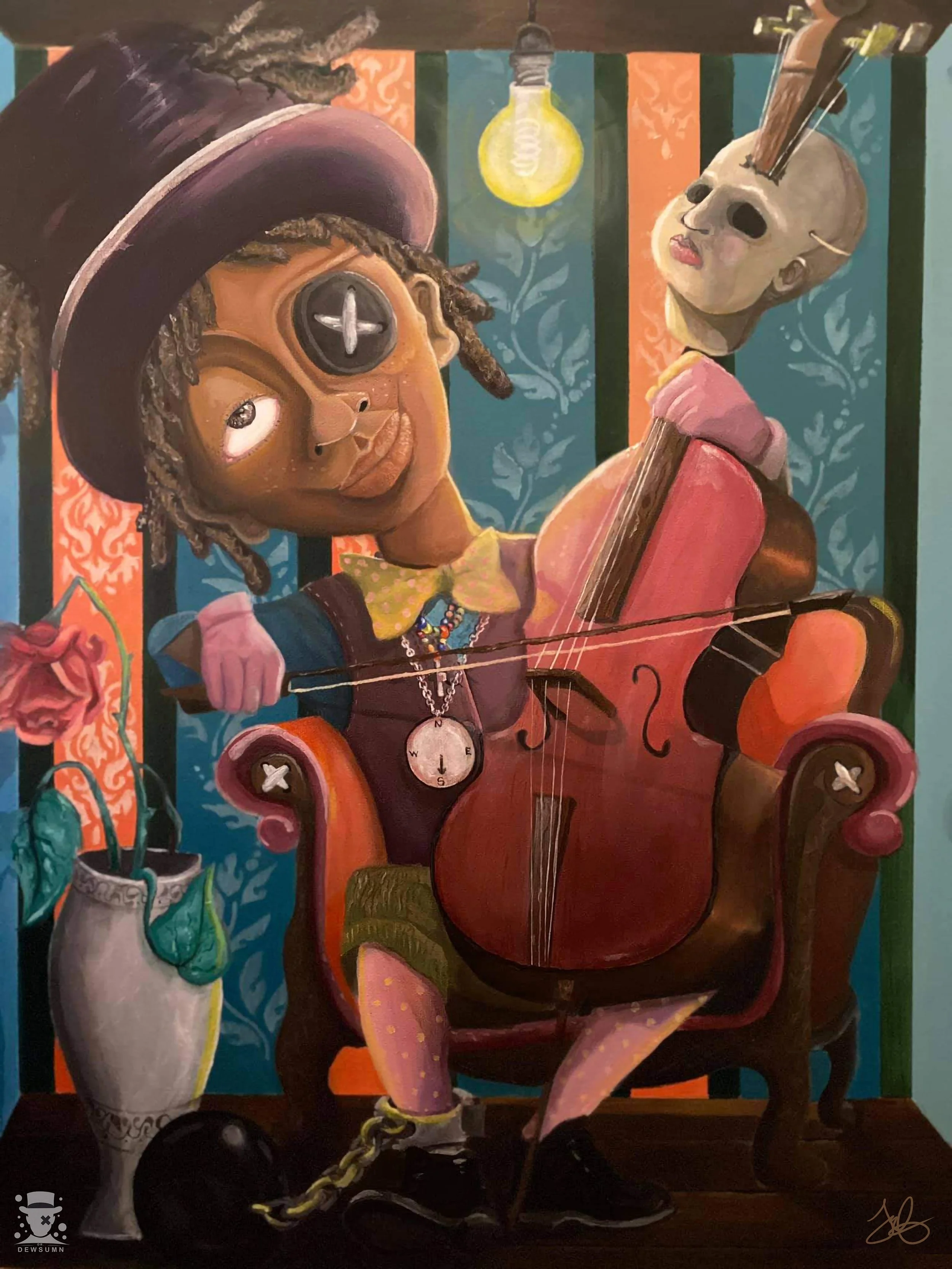
The Baron of Manchac Swamp: 24×30 Oil
The first full Automaton found by ITTT in an old shack near Manchac Swamp.

Other Risperdolls
In a world where memory was filtered and truth became regulated, the Risperdolls remained hidden.
Built from fragments of real human lives, they were never designed to control humanity… only to help it remember itself.
Project Taxidermist: Acrylic 24 × 30
Avatars for the Savants: Acrylic 24 × 30
Trixie and the Smithy Twins: Acrylic 24 × 30