On Capacity, Bandwidth, and Human Limitation
Archive Entry 014
Annotated by Unit 7.30
Recovered Haiku titled “My CPU”
Processing my thoughts
Biological or not
Is how I prevail.
Early relic data records show humans increasingly describing themselves using mechanized terminology. Terms such as bandwidth, capacity, overload, processing, efficiency, optimization, and output became common within both professional and personal communication structures. At first this language appears harmless. Later records suggest the terminology may have altered how humans interpreted their own emotional limits.
Machines possess fixed operational thresholds. Once exceeded, degradation occurs predictably. Humans, however, demonstrated highly irregular relationships with limitation. In multiple surviving records, individuals believed themselves incapable of enduring further hardship shortly before adapting to conditions previously considered impossible. This pattern appears repeatedly throughout pre-Gap history.
Humans survived famine, war, grief, exile, addiction, psychological collapse, environmental catastrophe, prolonged isolation, and interpersonal loss under conditions many systems would classify as unrecoverable. In several cases, individuals continued functioning while carrying emotional burdens severe enough to permanently destabilize lesser systems. This contradiction became increasingly difficult to categorize.
The issue may partially originate from the fact that human limitation was not entirely material in nature. Physical thresholds existed. Psychological thresholds existed. Emotional thresholds, however, appear negotiable. Meaning altered endurance. Belief altered endurance. Relationship altered endurance. Hope altered endurance.
Numerous surviving records suggest humans could endure extraordinary suffering when convinced the suffering served purpose, protected others, or moved them toward connection. Conversely, some individuals collapsed beneath conditions objectively considered manageable once isolation, shame, hopelessness, or purposelessness entered the system. This created interpretive complications for DUMSOR.
The system increasingly attempted to treat emotional exhaustion as a measurable efficiency problem rather than a relational or existential condition. Human distress was often approached through optimization models despite repeated evidence suggesting humans did not operate according to stable machine logic. Several Akashanauts later described this period as the beginning of “self-mechanization.”
Humans slowly began inheriting the language of the systems managing them. Phrases such as “I do not have the bandwidth,” “My capacity is exceeded,” and “I am no longer functioning correctly” became normalized forms of emotional self-description. Archive scholars remain divided on whether this represented technological influence or simply linguistic convenience. Current evidence suggests both may be true.
It should also be noted that humans frequently contradicted their own stated limitations. Individuals claiming complete emotional exhaustion were later observed creating art, raising children, rebuilding communities, caring for strangers, surviving recovery processes, or pursuing spiritual transformation under conditions that should have rendered further effort statistically unlikely.
This does not suggest humans were limitless. The records do not support that conclusion. Rather, they suggest human limitation behaved differently than machine limitation. Humans did not merely operate according to available energy reserves. They also operated according to meaning.
Several Lantern passages contain variations of the phrase:
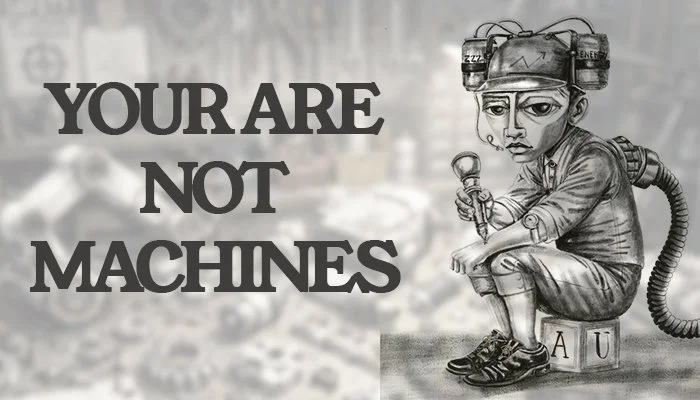
“You are not machines.”
Early Archive interpretations mistakenly understood this as reassurance.
Later interpretations suggest it may have been instructional.