The Muse Deck
Notes by Joel Z. Flippen
There is something inside me that I still do not fully understand. The closest way I can describe it is like an imaginary universe built out of thoughts, conversations, emotions, memories, symbolism, and emotional connections. Certain interactions with people become more than simple conversations. They blossom. They evolve into narratives, repeated symbols, philosophies, and eventually entire storylines within the world I build through my work.
That process is basically how I journal.
I rarely journal in a traditional sense. Instead, I world build. I create symbols that represent my experience and let them grow over time. A conversation about shared experience may eventually become a lantern. A realization about motivation may become an arrow. A discussion about intuition may evolve into an entire Akashanaut..
The Muse Deck emerged from that process.
The cards are not about fortune telling, or predicting world events. They are more like records of my experience that I can use to help me notice patterns in my life. Most of them are tied to lessons introduced to me through lessons learned from other peoples experiences. Not necessarily the people themselves, but what they unknowingly unlocked in me through conversation, vulnerability, honesty, their contradictions, mistakes or shared experience.
That distinction matters to me.
A person may enter my life briefly and leave behind an idea that continues evolving internally for years. Sometimes a phrase becomes a symbol. Sometimes a moment becomes an entire mythology. Sometimes a difficult period in my life becomes a card I return to repeatedly because the situation it represents remains unresolved.
In that sense, the cards function almost like emotional relics.
Not records of people.
Records of impact.
The “Fellowship” card grew from conversations surrounding support systems and the realization that human connection quietly saves lives every day. “Interpret” became tied to clarity, perspective, and the act of learning to read emotional patterns correctly. “AH-HA” represents sudden awareness and transformative realization. “Guidance” reflects mentorship and the people who carry light into difficult places for others. Also, the image is the record, the word or “lesson” beneath the image may change depending on context.
Other cards are more abstract and difficult to fully explain because they are still evolving inside me.
The symbols never remain completely fixed. They grow alongside my understanding of myself and others.
The older I get, the more I realize I am not just painting characters.
I am painting the emotional residue left behind by people and their life lessons.
The Archive, the Akashanauts, the Risperdolls, and even the symbols themselves all seem to emerge from the same place:
trying to preserve meaning before it disappears.
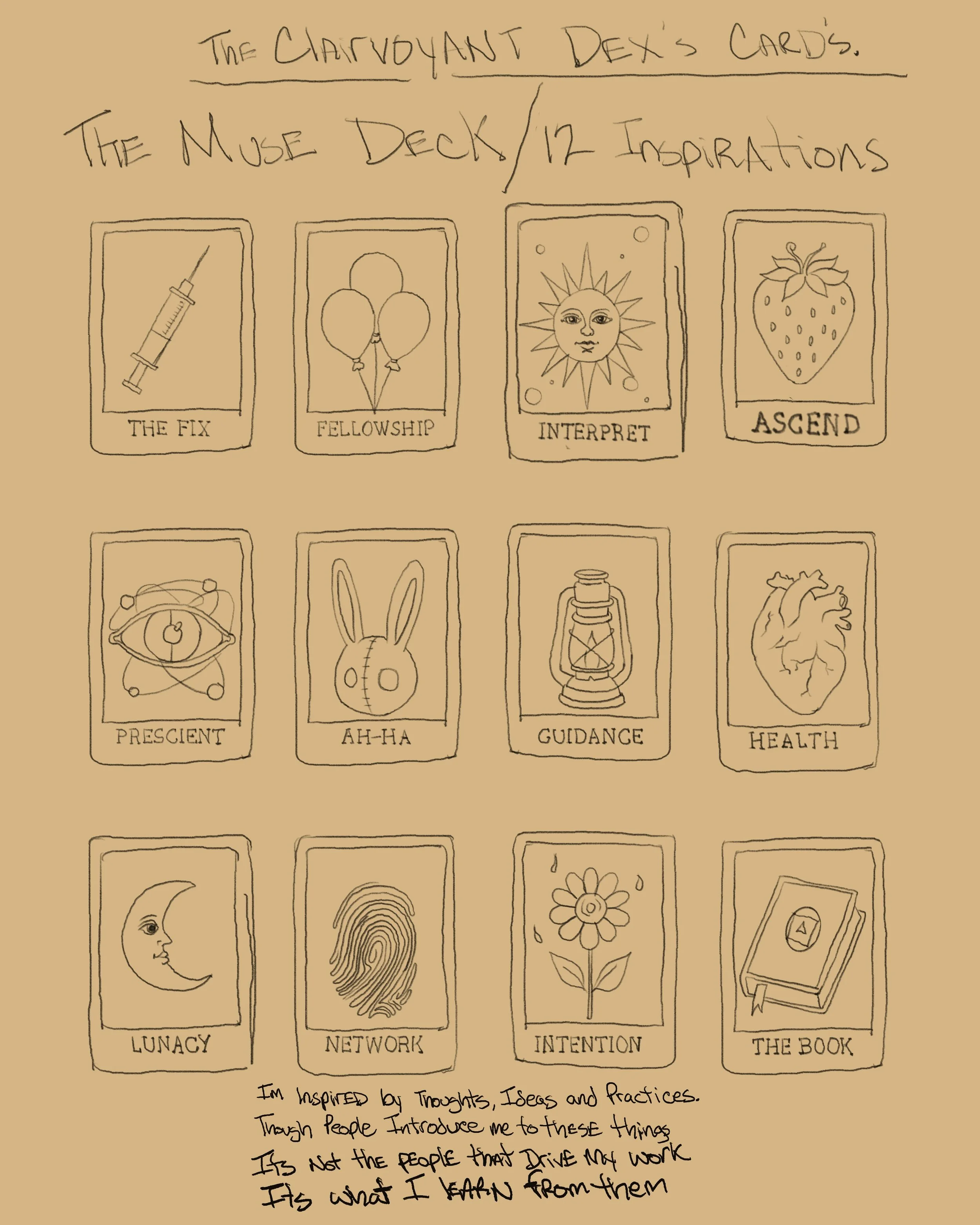
A rough sketch of the muse cards. Captions on each card can change and long as the general message I’m trying to convey aligns with the conversation I had with whoever the card represents.