How I Mistook Coincidences for Curses
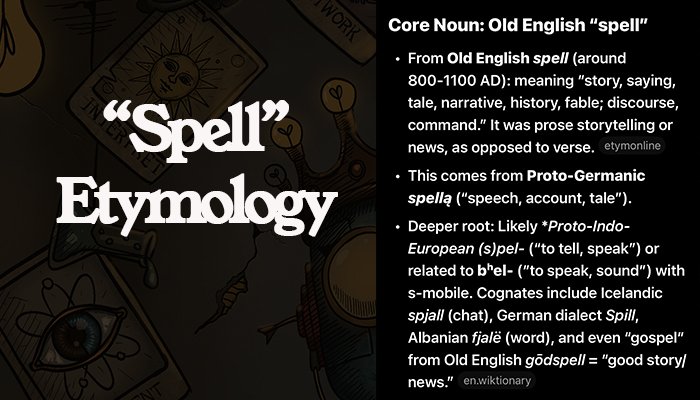
From “Spell” to “Gospel”
Notes by Joel Z. Flippen
“Semiology” (Haiku Sequence)
Prescient words are seen.
Predictions appear in spells.
The path is defined.What does it all mean?
Was the sun’s revealing tales
interpreting signs?Connections lay bare,
networks of confusing needs,
everyone unique.Now that I’m aware
of these tangled webs we weave,
intention will speak.Clarity I breathe.
As I’m ascending this peak,
the patterns repeat.— Dr. Dewsumn
Around my late twenties I began developing an irrational fear surrounding things like hex’s, rituals, coincidences, and synchronicities. My mother’s side of the family came from an environment where superstition, Roots, and Hoodoo were deeply woven into the local culture. Whenever something terrible happened that could not easily be explained, people often assumed something dark and paranormal was responsible.
Ironically, my mother raised us to reject those ideas completely.
Even though she was a Christian preacher, she was clear about not wanting us to fear imaginary darkness. She taught us that horror movies were fake, monsters were not hiding in the dark, black cats were not omens, and people were not secretly controlling reality through curses and rituals. We did not grow up believing in possession, demons lurking around corners, or supernatural punishment being concocted in a cauldron.
Still, I eventually fell into those same patterns of thinking as I aged.
When bad things started happening to me, especially during periods where I was struggling emotionally, or when I was experience mental breaks, I started transforming random events into narratives that made me feel targeted. I would notice coincidences surrounding my failures and convince myself something external was influencing my life negatively. Somewhere deep down, it felt easier to believe that someone had altered the universe against me than to fully confront the role my own decisions were playing.
Then one day self-awareness caught up with me.
I realized my ego desperately wanted to avoid accountability. It wanted to preserve the idea that I was uniquely cursed rather than honestly admitting I was repeating unhealthy patterns I refused to address. Looking back now, some of those thoughts sound almost laughable to me, but at the time they felt completely real. Fear has a way of making patterns feel supernaturally dark when we do not want to face ourselves directly. Even now, by addressing my ego rather than just saying “me” I am in someway, avoiding full accountability.
During my healing journey, through conversations with mentors, fellowship, and community, my perspective on synchronicities began changing. I stopped viewing coincidences and patterns as proof that something external was attacking me and started asking whether they were pointing toward something internal I needed to confront.
That distinction changed everything.
I started realizing I had been facing many of the same emotional situations repeatedly throughout my life, only wearing different masks each time. Guilt, fear, low self-esteem, motivation, shame, resentment, avoidance, validation seeking… the surface details changed, but the emotional architecture underneath often remained the same.
Once I became aware of this, synchronicities stopped feeling demonic and started feeling diagnostic.
For example, if I am avoiding taxes, suddenly I notice every TurboTax commercial, every H&R Block pamphlet, every conversation about debt, and every use of the word “owe.” Not because the universe is haunting me, but because my mind is hyper-focused on unresolved tension I am refusing to face.
The same thing happens emotionally.
If I am carrying guilt, fear, insecurity, dishonesty, or unresolved motivation, my attention begins locking onto patterns related to those internal conditions. Conversations feel strangely connected. Certain phrases repeat. Stories from other people begin mirroring my own experiences. Coincidences start stacking on top of each other until they almost feel impossible to ignore.
Today, instead of fearing those moments, I try to slow down and examine them.
I pray on them unselfishly and ask what I need to learn that might help me become more useful to others. I discuss these patterns with people I trust in my fellowship and community. I listen closely to their stories, and the lessons hidden inside their experiences. That storytelling process is important because it helps me see myself more clearly without becoming trapped inside my own perspective.
Sometimes this process takes weeks.
Sometimes I fail entirely and repeat the pattern again.
But other times I grow.
The synchronicities still appear, the patterns still repeat, but I recognize them earlier and respond differently than I would have before.
I think that difference matters.